Showing posts with label Polymath Project. Show all posts

Sunday, November 4, 2018

More Collaboration and Less Collusion!


via Redbooth.com

January marks the 10-year anniversary of the collaborative “Polymath Project” begun by Fields Medalist Tim Gowers. Let’s celebrate early!
Here is the main page for the Project:
…and here is the Tim Gowers posting that originally proposed such a crowdsourcing effort be attempted:

I find it interesting how little widespread digital collaboration has made a dent in other sciences, but been productive in mathematics — one suspects there’s some sort of whole sociological dissertation that could be written here! (although perhaps the pen-and-paper, and computer-assisted nature of mathematics makes it more suited to such endeavors than other more applied sciences)
Anyway, Vicky Neale in her fabulous volume “Closing the Gap,” writes a lot about Polymath’s contributions to the ongoing work on the Twin Primes conjecture. She includes many wonderful quotes from Gowers along the way. Here he is when first proposing a digital collaboration on significant unsolved math problems:
“The ideal solution would be a solution of the problem with no single individual having to think all that hard. The hard thought would be done by a sort of super-mathematician whose brain is distributed amongst bits of the brais of lots of interlinked people. So try to resist the temptation to go away and think about something and come back with carefully polished thoughts: just give quick reactions to what you read and hope that the conversation will develop in good directions.”
Neale then writes, “Gowers was very keen to encourage participants to share their immediate thoughts, rather than working on ideas independently in private, with an emphasis on expressing their immediate thoughts as clearly as possible so that others could build on them.” 
And then she quotes Gowers again:
“When you do research, you are more likely to succeed if you try out lots of stupid ideas. Similarly stupid comments are welcome here. (In the sense to which I am using ’stupid,’ it means something completely different from ‘unintelligent’. It just means not fully thought through.)”
Later on he writes, “…even ‘frivolous’ observations can (and should) be posted on this thread, if there is even a small chance that some other participant may be able to find it helpful for solving the problem.
“Similarly, ‘failed’ attempts at a solution are also worth posting: another participant may be able to salvage the argument, or else the failure can be used as a data point to eliminate some approaches to the problem, and to isolate more promising ones.”

Gowers also foresaw the problem of assigning 'credit’ for such widespread collaborations, and so addressed that ahead of time as well:
“Suppose the experiment actually results in something publishable. Even if only a very small number of people contribute the lion’s share of the ideas, the paper will still be submitted under a collective pseudonym with a link to the entire online discussion.”
Later in the book Neale references how Terry Tao deferred to recent-grad James Maynard to insure he would get the most credit for advances to the Twin Prime conjecture that both had made independently — Tao, absolutely established in his field with no need for acclaim, knowing that credit to Maynard might boost his career greatly — I don’t know that this type of gesture/collegiality would occur very often in any field outside of mathematics!
At this point the Polymath Project has met much success (with fits and starts) and is working on its 16th project. Congratulations to all participants involved, and to Tim Gowers' foresight. As the post-title above suggests, here's to more collaboration in life, and less collusion! ;)

For entertainment purposes only, I’ll end with a completely different take on collaboration in math, in the form of a wonderful short piece of film fiction (on the Goldbach conjecture) that I haven’t re-posted for awhile — for any who have never seen it, “The Calculus of Love”:


Wednesday, March 5, 2014

The New Culture of Collaboration


Nice piece in Nature about the rise of collaborative Web efforts in science, with special focus on Tim Gowers' ongoing Polymath Project (started as an experimental project in 2009):

http://www.nature.com/news/crowd-sourcing-strength-in-numbers-1.14757
"Gowers' online challenge was a radical suggestion for mathematics — a field that is often viewed as the domain of lonely, secretive figures who work for years in isolation. And it went against the grain of the wider academic culture, which tends to encourage researchers to share their ideas only by publishing them."
The article points out that there are now some commercial or incentivized collaborative projects as a way to increase participation, with even the Government getting involved: https://challenge.gov/

Business, mass education, and social media (and porn!) may be among the Web's most dominant uses, but I've long thought that truly the most ideal and promising use of the Internet would come in the form of scientific collaboration… the hive-mind solving problems, one-after-another, in a fraction of the time formerly required, leading to an exponential growth of knowledge/progress previously inconceivable. We've barely just begun... kudos to Gowers, Terence Tao, and others at the forefront.


Wednesday, November 20, 2013

Of Primes and Probability


Two bits for a Wednesday...:

1) In a fascinating long-read for Quanta Magazine, Erica Klarreich covers the astounding progress so far made in the "prime number gap" of the Twin Primes Conjecture, in just six months since Yitang Zhang postulated a limit to the gap of 70 million!:

http://tinyurl.com/pw6hyyz

James Maynard, a post-doc, has wrestled the gap down to no more than 600, well below the result that even Terry Tao's Polymath group had yet achieved.

an excerpt to whet your appetite:
"Zhang’s work and, to a lesser degree, Maynard’s fits the archetype of the solitary mathematical genius, working for years in the proverbial garret until he is ready to dazzle the world with a great discovery. The Polymath project couldn’t be more different — fast and furious, massively collaborative, fueled by the instant gratification of setting a new world record.
"For Zhang, working alone and nearly obsessively on a single hard problem brought a huge payoff. Would he recommend that approach to other mathematicians? 'It’s hard to say,' he said. 'I choose my own way, but it’s only my way.'
"Tao actively discourages young mathematicians from heading down such a path, which he has called  'a particularly dangerous occupational hazard' that has seldom worked well, except for established mathematicians with a secure career and a proven track record. However, he said in an interview, the solitary and collaborative approaches each have something to offer mathematics.
“ 'It’s important to have people who are willing to work in isolation and buck the conventional wisdom,' Tao said. Polymath, by contrast, is 'entirely groupthink.' Not every math problem would lend itself to such collaboration, but this one did."

2) I mentioned a couple of posts back that in the Preface to his new book ("Will You Be Alive 10 Years From Now?") Paul Nahin gives an example of a Marilyn vos Savant column where the famous Mensa-ite gives the WRONG answer to a math question and sometime later corrects herself. The question, and her initial ill-fated answer ran as follows:
Q.: "I manage a drug-testing program for an organization with 400 employees. Every three months, a random-number generator selects 100 names for testing. Afterward, these names go back into the selection pool. Obviously, the probability of an employee being chosen in one quarter is 25 percent. But what’s the likelihood of being chosen over the course of a year?"

A.: "The probability remains 25 percent, despite the repeated testing. One might think that as the number of tests grows, the likelihood of being chosen increases, but as long as the size of the pool remains the same, so does the probability. Goes against your intuition, doesn’t it?"
Nahin points out that the actual probability of being chosen at some point during the four quarters of testing works out to 0.6836, considerably greater than Marilyn's 0.25.

In a later column Marilyn 'fessed up, "My neurons must have been napping" and corrected herself:

http://www.parade.com/45916/marilynvossavant/22-sunday-column-2/

You can also see the math involved at this Forum site where the problem was discussed:

http://www.aiqus.com/questions/34413/ask-marilyn-new-probability-question-controversy


Thursday, October 24, 2013

Go Gowers!


This is waaaay (as in leaps-and-bounds) beyond my brainpower, but still I find the latest post from the always-worth-reading Tim Gowers, fascinating… he proposes to utilize a polymathematical (collaborative) approach to test an idea that he thinks (but also doubts) may have some merit, to the P vs. NP Millennium problem. Before even getting to the idea he wants to consider, he spends considerable time on the pros and cons of such a collaborative undertaking. It's a verrry long, and before the end, a very deeeep read, but if you're particularly interested in P vs. NP, or just in the polymath approach to problems, highly recommended:

http://gowers.wordpress.com/2013/10/24/what-i-did-in-my-summer-holidays/

I'm guessing that RJ Lipton's blog may have some response to Gower's proposal (or maybe he'll just send along a comment to Tim's blog), so if the subject does interest you, might be worth monitoring that as well:

http://rjlipton.wordpress.com/


Thursday, June 6, 2013

Hive Mind and Collaboration… Driving the Future


(via Waugsberg/Wikimedia)
Yitang Zhang's recent proof regarding twin primes keeps generating press pieces… including some good recent ones for lay readers, first from the Wall Street Journal:

http://www.livemint.com/Opinion/fodS89bFVdFCaO17Sh9fLN/From-70-million-to-two.html

and then from popular science-writer Amir Aczel over at HuffPost Science:

http://www.huffingtonpost.com/amir-aczel/the-mystery-of-the-primes_b_3391666.html

And finally, this update from New Scientist:

http://www.newscientist.com/article/dn23644-game-of-proofs-boosts-prime-pair-result-by-millions.html

(I think all 3 of these are worth a gander as they touch on different aspects of the twin prime/Zhang story.)

Things are moving fast… Zhang's work was quickly taken up by a bevy of individual mathematicians, and now also by the Polymath Project group (a Web collaboration of many mathematicians). Zhang's computed upper limit of ~70 million has, in just a few brief weeks, been reduced to under 400,000! (the latest figure I've seen, but it will keep changing). Phenomenal!

The Polymath Project (largely inspired by math icons Tim Gowers and Terry Tao) is, to my mind, an example of the premier use of the internet, to utilize the 'hive mind,' as never before in history, to solve or work on significant problems (in this case math, but it can be applied to other subject areas). In the past, dozens or perhaps 100s of individuals could be brought together to work somewhat collaboratively on a problem, but today 100s of 1000s can be easily drawn from. Books have already been written about the power of the "hive mind" (some quite critical). Solutions to many problems will come at a warp-speed previously unattainable. Can the 'hive mind' be cluttered with junk science… pseudoscience… quackery… tomfoolery… Yes, of course, GOBS of it;  But the beauty of the hive is how rapidly and efficiently it can sort through masses of information and ignorance to arrive at the productive core. "Open access," "crowdsourcing," collaboration, and the hive, are the wave of the future.

My current post over at MathTango is a doff-of-the-cap to those leading the way in the current evolution (revolution???) of math education, with a focus, by the end, again on how rapid/broad Web collaboration is currently leading the way to shape the 'flipped classrooms' and MOOCs of the near future… and, obviously, so much more.


Wednesday, May 2, 2012

Polymath Redux

Speaking of crowd-sourcing (as yesterday's post did)... I've reported on Tim Gowers' collaborative Polymath Project in the past, but it's been awhile. Here though, a critical review/update on the Polymath concept from a "bystander":

http://boolesrings.org/krautzberger/2012/04/30/waiting-for-the-polymath-revolution-thoughts-from-a-bystander/

I can't help but think the author is overly critical in seeming to view the Polymath effort as not revolutionary enough, and not including enough of the mathematics community. I view it (like I view Khan Academy) as being young and still a work-in-progress. I'm not certain it's even meant to be "revolutionary," so much as simply productive. And the author seems to  want to spread the wealth of that productivity to the broader math community; I just don't know how practical that will be given the Polymath focus on highly complex problems. The author actually summarizes well though the basic potential of the Project:
"Mathematics has the greatest potential for 'doing research online'. There’s no physical entity needed and our primary standard of scientific communication is the written word. There’s nothing in mathematical research that cannot be digitalized. We will never face the problem that somebody on the other side on the net would have to actually look at our specimen, our antibody staining, our test subjects. The web works perfectly for us.
Hence, mathematicians could be at the forefront of experimenting with new research activities that use the connectivity the web can offer in new and imaginative ways."
In the end though the author pleads, "...please, for a change, let’s not ask Tim Gowers to do everything for us!"

Anyway, an interesting discussion...

Thursday, April 14, 2011

The Polymath Project... Redux


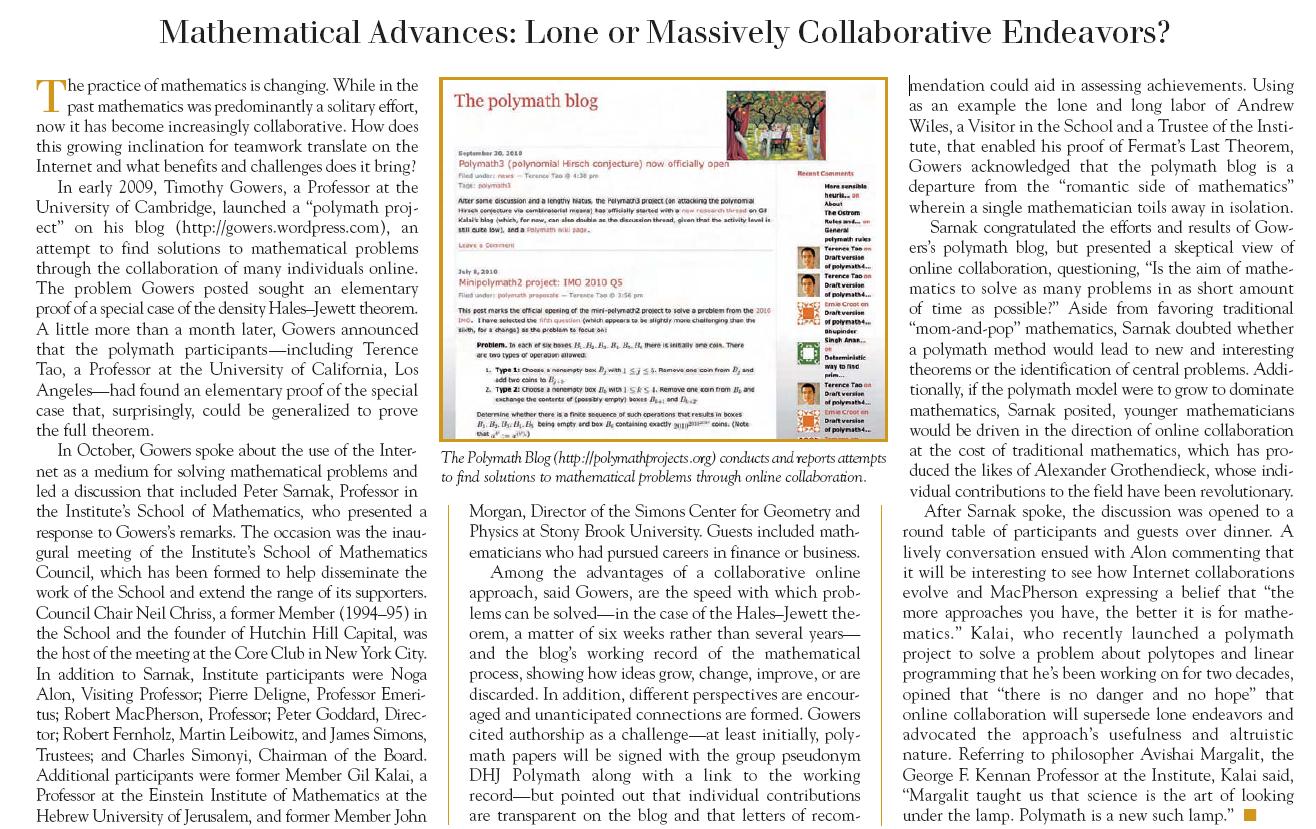
"The practice of mathematics is changing. While in the past mathematics was predominantly a solitary effort, now it has become increasingly collaborative. How does this growing inclination for teamwork translate on the Internet and what benefits and challenges does it bring?"

That's the opening of an interesting article on Tim Gowers "Polymath Project" -- essentially a collaborative forum for solving difficult math problems over the Web. I've reported on this topic in the distant past, and am a huge fan of (but non-participant in) the approach. The full article here:

http://polymathprojects.files.wordpress.com/2011/03/polymathias.jpg

The Project's blog is here:

http://polymathprojects.org/

Thursday, August 5, 2010

More Polymath...

I've previously referenced Tim Gowers' collaborative Polymath Project (using the power of many to solve difficult math problems), and here's another nice article on it from Scientific American:

http://www.scientificamerican.com/article.cfm?id=problem-solved-tic-tac-toe-blog

The polymath blog is here:

http://polymathprojects.org/

And here's a more general wiki-page of various polymath projects:

http://michaelnielsen.org/polymath1/index.php?title=Main_Page

Lastly, in a related note, this recent interesting NY Times story reports how (non-scientist) video gamers have contributed to the understanding of complex biological protein-folding through the competitive (and collaborative) use of a  video game created for such purposes:
http://tinyurl.com/2gx3hw4