Showing posts with label Martin Gardner. Show all posts

Sunday, June 30, 2019

When Martin Let Me Down...


It's Sunday, so, hey, something a little preachy...
I recently stumbled across a post on my former MathTango blog from 2 1/2 years ago that I didn’t even remember writing (remembered thinking about it, just not ever actually posting it!). It touches on some matters I was recently thinking about again, so will re-post here with minor revisions:

We’ll start with a news story (…because we live in this wonderful time when you get to make up any damn thing you want and pass it along as "breaking news"):

==> According to top-classified PRIME Security documents uncovered by TMD special investigator Alexus Jones, the Donald Trump we see is in fact an electronic Slovenian-built, fully-programmable cyborg under direct control of long-time Moscow operative Melania Kvorniporakovski and her Russian handlers (no one, for example, has ever seen him actually use a rest room)….

Que sera sera…. (p.s… by the way, the beauty of fake news is that it's difficult to prove false since one can just add further layers of lies to keep it going).

Moving on….
There were many factors for Hillary Clinton's 2016 election defeat, but the simplest is that James Comey’s late intervention torpedoed her campaign, halting her momentum and moving many undecideds (cringing at the prospect of hearing about emails for the next 4 years), over to the Donald side. Without that single news event all indications are HRC would've won, and of course she DID win the popular vote handily. But with that said, at least the Comey announcement was an actual news event. 
Another factor that got a lot of attention is all the “fake news” reports that were passed along (and believed), especially on social media, by the unaware (or dare I say, the none-too-bright)… some of it so ridiculous on-its-face as to bode ill for Democracy’s future! Which leads to the two topics I want to raise here. Because... what-the-hell is wrong with people's basic reasoning skills these days!?

American demographics are changing; specifically the percentage of older people, say 70 and over, is far greater than in the past relative to the number of young people, say 30 and under. Medical/health advancements and lower birth rates mean age proportions are becoming more skewed all the time.
But ANOTHER potential skewing is FAR more controversial...
It has been called "dysgenics" or 'retrogressive or backward or reverse evolution' (the opposite of eugenics). Unfortunately, controversial Nobel-Prize winner William Shockley brought the idea to public attention decades ago, though it well-precedes him in the biology community. If you remove notions of race and IQ from the discussion, the more general concept is worth reviewing as a partial explanation for the anti-intellectualism, anti-science, anti-establishment, and fringe views on prominent display these days. 

Shockley spoke out at a time that the "Zero Population Growth" movement, family-planning, and widespread access to birth control were first spreading across America. In brief, his idea was that the most educated, most successful, most fit individuals were primary practitioners of these new trends, while the least educated, least successful, and least fit, were largely unaware of, or uninterested in, such trends. In short, the most fit, capable couples were often deliberately limiting families to 2-3 children at most, while their less fit (less capable) counterparts were more likely to have 4 or more offspring, who in turn grew up in less ideal conditions, received less education, were generally less fit or successful, and continued the cycle — self-perpetuated skewing (of ability and education). 

70 years since the world collectively said "never again," the rise of xenophobia, anti-semitism, isolationism/nationalism, anti-elitism, anti-science, and simplistic-thinking across the globe is unmistakeable, and may coincide with factors Shockley noted decades ago. 
An alternative explanation for recent political events specifically in the U.S. is that the right-wing have always been a part of the American populace, but were not very active politically in prior generations. Beginning in the 1960’s the Republican Party deliberately set out to contact, coddle, mobilize, and activate conservative rural and fundamentalist elements (the so-called  "Silent Majority") through targeted mass mailings and talk radio... and now also with digital social networking. They were successful -- millions who were never previously active in politics now suddenly are... and they've changed the very nature of the Republican Party (for many formerly key figures in the GOP it's a case of 'be careful what you wish for' as they've essentially lost their Party).

In any event, if the numbers of less-educated, less critically-thinking people have risen in recent decades (partly perhaps because dysgenics, mathematically-speaking, may be baked into the demographics), then widespread quality education, starting early, may be the only antidote to all this. Which leads me finally to Martin Gardner….

The greatest skeptical mistake Gardner ever made, in my opinion, was his derision of non-Aristotelian "General Semantics."  While some elements of G.S. (and its founder, Alfred Korzybski) are easily critiqued, the broader intent and purposes of G.S. were admirable. G.S. fundamentally trains people to be aware of the many ways, words and language manipulate thinking, perception, decision-making. In short, it assists in 'critical thinking,' in dismally short supply these days. 
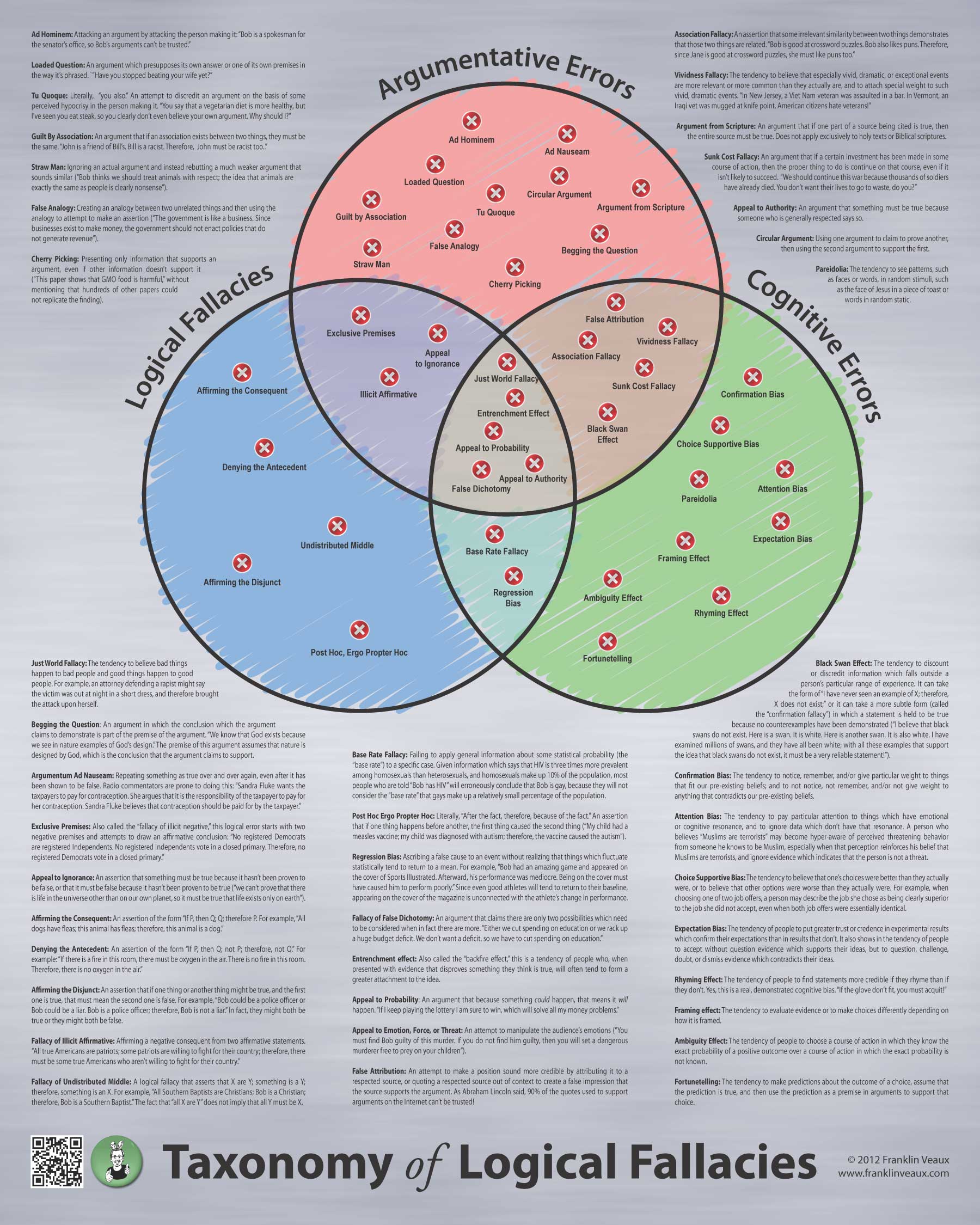
Gardner, of all people, should have been a fierce adherent of G.S.; instead his scorn helped make it a fringe field, doing for G.S. what Noam Chomsky did for “behaviorism” in psychology. In fact I don't know of any way to teach people critical (and skeptical) thinking without employing tenets from General Semantics. They are simple and basic, yet often not internalized by people without some instruction. G.S. inculcates a wariness of language in advertising/marketing, politics, relationships, religion, news-coverage, and even science, and a recognition of the subtle dogmatism that infuses so much communication. On a sidenote, here are a couple of popular 'taxonomies of logical fallacies' which actually relate back (unknowingly) to a number of G.S. basic principles:

(You may be able to embiggen them on your screen for better readability, or download them -- they ought be somewhere in every high school, IMO!)

It amazes me that secondary students are still forced to read Shakespeare or Dickens or Hardy, but never taught rudiments of how language operates on our cognition, a far more important faculty in today's world (indeed it's amazing/disappointing how many life skills are NOT taught in our schooling, but left almost to chance!).

I won’t try to summarize G.S. principles here, and I haven’t kept up with G.S. volumes over the years, but two of the old popularizations (there are many) that most influenced me were:
Language In Thought and Action  by S.I. Hayakawa
The Tyranny of Words  by Stuart Chase

In its own way, Alan Sokal’s “Beyond the Hoax,” which I’ve referenced before, also touches on many of these issues. I was a bit miffed some time ago to see Ben Goldacre, in a tweet, imply (if I interpreted it correctly) that Sokal’s hoax may have actually contributed to the large-scale mistrust people now exhibit towards science and academics. That’s not true at all; on the contrary Sokal’s target was specifically 'postmodernism,' and some of the ’softer’ disciplines that brush on a mere veneer of science instead of the real thing. We need more Alan Sokals, not fewer, to combat the growing anti-elitism, anti-science sentiments thriving today.
Anyway, at the bottom of the page I’ve also tacked on a couple of weblinks that further detail the whole rift between Gardner and G.S. Some people even viewed G.S. as a “cult,” in part probably because L. Ron Hubbard was said to have incorporated parts of it for his early “Dianetics” program, but many of G.S.'s principles are broad enough that they can be incorporated in any number of programs.

In fairness to Gardner I will note that he was less critical of the “popularizers” of G.S. than of its Korzybskian foundations and some of its technical notions.

In his autobiography Gardner uses an example of how "E-prime," a G.S. idea that never caught on (which advocated avoiding all forms of "to be"), would alter some simple doggerel. Here’s an example of an E-prime version on left versus standard on right in parentheses:

Roses look red  (Roses are red)
Violets look blue  (Violets are blue)
Honey tastes sweet   (Honey is sweet)
As sweet as you

I suppose to many (like Gardner) these may seem trivial, innocuous changes, but buried in language/words are deep meanings/mindsets and effects, and the effects of these two versions ARE different (the first being more accurate, less dogmatic; the second being assertive, but unprovable and potentially inaccurate). Emotions, prejudices, ambiguity are intrinsically buried and maintained in our language use. I’m a bit flummoxed that a writer as clear and incisive as Gardner didn’t show a deeper grasp of how words (dangerously) manipulate people. If you think that words like "chairman," "fireman," and "policeman" are sexist and ought be changed to "chairperson," "fire fighter," and "police officer" then you believe in elements of G.S.

Or take a different short sentence: “Mary had a little lamb.” 
Sounds simple; you likely think you understand it. But in fact you CAN’T really understand it without more context because it has too many possible meanings. Just emphasizing different words shifts the meaning:
MARY had a little lamb.
Mary HAD a little lamb.
Mary had a LITTLE lamb.
Mary had a little LAMB.

And putting these varying sentences into different extended contexts can further significantly alter what is being said. The point is that routine language (that we take for granted) is imprecise and ambiguous, yet people react to it as if it is clear and explicit. I’m using minor examples here, but there are far more nefarious ones out there in the world (especially in this day of bountiful conspiracy theories and lies).

There is some irony that a spurned figure like Shockley was perhaps prescient in foreseeing where the U.S. was headed, while Gardner’s much-touted skepticism led him to rebuke one program that could have prevented this electoral outcome; prevented the very gullibility and irrationality he spent his adult life battling.

Properly taught at young ages, General Semantics, would be an antidote to the nationalism, anti-elitism, anti-intellectualism we now face. Though it is still around, G.S. basically flopped back in the 50s/60s, shortly before the time that Shockley began worrying aloud about dysgenic factors in this country. 50 or 60 years later a demagogue gets elected President of the U.S. Well, no shit Sherlock!! ;-)
As a self-described “democratic-Socialist,” Gardner would be spinning in his grave (or wherever), at the 2016 election outcome. But I’m here to say, even if a bit facetiously, that he was unknowingly partially responsible. And the trend is no better in many other democracies. Fascism will always hold appeal for an unaware or angry populace.

p.s… an aside: I once briefly mentioned to Jim Propp my disappointment in Gardner’s failure to take General Semantics seriously, and he countered that every fan of Martin has some one beef with Gardner -- some particular thing they think he got very wrong. So rest-assured, in that context, I still consider myself a typical, inveterate admirer of Martin, but as a skeptic and even a word-maven, how he missed the essence and significance of what G.S. tried to teach I’ll never quite fathom.

For anyone wanting to know more about the Gardner/G.S. clash here are a couple of pages that go into further detail:


Monday, June 17, 2019

Marilyn and Martin


Just an old article I linked to over a year ago and am passing along again, because it's such an interesting backstory:


It's about the (working) relationship between Marilyn vos Savant and Martin Gardner, and about a slim oddball volume Marilyn penned back when Andrew Wiles 'proved' Fermat's Last Theorem.


Monday, August 22, 2016

Life of Gardner...


Another YouTube video today, this time from Martin Gardner's official biographer, Dana Richards... over an hour long, but worth it if you're a Martin Gardner fan; lots of good stuff and interesting tidbits in addition to fairly well-known information about Martin:


(p.s... yesterday's 'Sunday reflection' came from Gardner)


Sunday, August 21, 2016

Dissolving Into Pure Mathematics


Sunday reflection, via Martin Gardner:
"In light of today's physics the entire universe has dissolved into pure mathematics. The cosmos is made of molecules, in turn made of atoms, in turn made of particles which in turn may be made of superstrings. On the pre-atomic level the basic particles and fields are not made of anything. They can be described only as pure mathematical structures. If a photon or quark or superstring isn't made of mathematics, pray tell me what it is made of?"

Sunday, January 4, 2015

Gardner Reflects...


What better way to begin a new year of Sunday reflections than with some words of reflection from Martin Gardner (from his autobiographical "Undiluted Hocus Pocus"):

"Writing the column for more than twenty-five years was one of the greatest joys of my life. If you look over all my columns you'll find that they steadily become more sophisticated mathematically. That was because I was learning math. I had not taken a single math course in college, although I loved the low-level math I learned in high school. And I had always been fond of recreational math ever since I was introduced to it as a boy by Sam Loyd's mammoth Cyclopedia of puzzles.
"One of the pleasures in writing the column was that it introduced me to so many top mathematicians, which of course I was not. Their contributions to my column were far superior to anything I could write, and were a major reason for the column's growing popularity. The secret of success was a direct result of my ignorance. Even today my knowledge of math extends only through calculus, and even calculus I only dimly comprehend. As a result, I had to struggle to understand what I wrote, and this helped me write in ways that others could understand.
"


[…If you have a favorite math-related passage that might make a nice Sunday morning reflection here let me know (SheckyR@gmail.com). If I use one submitted by a reader, I'll cite the contributor.]


Tuesday, October 21, 2014

He'd Be Embarrassed By All the Attention...


Wasn't planning to do a post on Martin Gardner's Centennial today (...I did my little reflection post on him this past Sunday), since I've covered him plenty in the past, and knew many others would be paying tribute this week. But so many good posts have gone up, I don't want to ignore them, and thus offer a small sampling below.
It's impossible to overdose on Martin Gardner, incredible thinker/writer that he was (who hardly took a math course beyond high school!), so enjoy...  (possibly I'll add additional links in next 24 hrs., but really there are too many to choose from!):

http://www.bbc.com/news/magazine-29688355

http://www.theage.com.au/national/education/martin-gardner-and-mr-hyde-20141016-3i584.html

http://wordplay.blogs.nytimes.com/2014/10/20/mg100-2/?_php=true&_type=blogs&smid=tw-share&_r=0

http://plus.maths.org/content/five-martin-gardner-eye-openers-involving-squares-and-cubes

http://headinside.blogspot.com/2014/10/100-years-of-martin-gardner.html

Also, my year-old review of Gardner's autobiography here:
http://mathtango.blogspot.com/2013/10/undiluted-martin-gardner.html

ADDED:  http://en.chessbase.com/post/martin-gardner-s-100th-anniversary

One suspects Martin is now somewhere off demonstrating the joy of hexaflexagons to a whole new audience of enthralled angels... or, just maybe, he and Paul Erdös are sitting together, sipping coffee, and excitedly reading each other passages from "The Book." ;-)


Sunday, October 19, 2014

A Martin Gardner Sunday


This coming Tuesday marks the 100th anniversary of Martin Gardner's birth, so for a Sunday reflection, some quotes about the man:
[several of these are taken from the Martin Gardner "testimonial" page: http://martin-gardner.org/Testimonials.html ]

Douglas Hofstadter, in tribute to Martin, upon his death in 2010:
"This is really a sad day…  sad because his  [Gardner's] spirit was so important to so many of us, and because he had such a profound influence on so many of us. He is totally unreproducible -- he was sui generis -- and what's so strange is that so few people today are really aware of what a giant he was in so many fields -- to name some of them, the propagation of truly deep and beautiful mathematical ideas (not just "mathematical games", far from it!), the intense battling of pseudoscience and related ideas, the invention of superb magic tricks, the love for beautiful poetry, the fascination with profound philosophical ideas (Newcomb's paradox, free will, etc. etc.), the elusive border between nonsense and sense, the idea of intellectual hoaxes done in order to make serious points... and on and on and on and on. Martin Gardner was so profoundly influential on so many top-notch thinkers in so many disciplines -- just a remarkable human being -- and at the same time he was so unbelievably modest and unassuming. Totally. So it is a very sad day to think that such a person is gone, and that so many of us owe him so much, and that so few people -- even extremely intelligent, well-informed people -- realize who he was or have even ever heard of him. Very strange. But I guess that when you are a total non-self-trumpeter like Martin, that's what you want and that's what you get."
***************************
"Several decades passed by before I rediscovered the elegance, simplicity, and depth of his writing, and most importantly, the validity of his approach to mathematics. Then, in due course, I had the great pleasure of meeting him in his old age. He was nothing like the stern-looking man on all those book covers: in reality he was a sweet-natured, kind, wise and modest to a fault, with a twinkle in his eye, and a total joy to be with. While I can't say that Martin's columns or books steered the early course of my life, his extraordinarily diverse written legacy, his devotion to learning, his generous sharing of his toys, and his sheer decency, all conspired to reset my course in midlife.
He was also extremely egalitarian and generous with his time: he didn’t care if you were a prince or a pauper, if you had an interesting idea then he wanted to know about it, and he’d encourage you to get it in front of others. In a sense he was the original (mathematical) community organizer, at a time when it was neither profitable nor popular."
-- Colm Mulcahy  
***************************
"Martin Gardner was an artist of mathematical writing. His work stands and will continue to stand the test of time. It is a springboard for others. I can gaze and contemplate his work over and over and see new things and create new ideas."
-- Tim Chartier
***************************
 "All of us who dare to aim our writing at 'the general reader' follow as best we can in Martin's footsteps. He is the Archimedes of mathematical writing."
        — Keith Devlin
***************************
and this:
"We glibly talk of nature's laws
but do things have a natural cause?
Black earth turned into yellow crocus
is undiluted hocus-pocus."

-- Piet Hein
used as the frontispiece to Martin's autobiography, "Undiluted Hocus Pocus"
***************************

To conclude, this wonderful, older and rare (14-min.-edited) interview with Martin was uploaded this week to YouTube... delightful:


Finally, CelebrationOfMind.org has this tribute page running this month in honor of the Gardner Centennial:
http://www.celebrationofmind.org/OCTOBER.html


Sunday, August 3, 2014

Sunday Morning With Max and Martin


"The Mathematical Universe Hypothesis offers a radical solution to this problem: at the bottom level, reality is a mathematical structure, so its parts have no intrinsic properties at all! In other words, the Mathematical Universe Hypothesis implies that we live in a relational reality, in the sense that the properties of the world around us stem not from properties of its ultimate building blocks, but from the relations between these building blocks. The external physical reality is therefore more than the sum of its parts, in the sense that it can have many interesting properties while its parts have no intrinsic properties at all."

-- Max Tegmark from "Our Mathematical Universe"

…and in a footnote on the same page Max pushes the idea further, writing:

"Our brain may provide another example of where properties stem mainly from relations. According to the so-called concept cell hypothesis in neuroscience, particular firing patterns in different groups of neurons correspond to different concepts. The main difference between the concept cells for 'red,' 'fly,' and 'Angelina Jolie,' clearly don't lie in the types of neurons involved, but in their relations (connections) to other neurons."

Martin Gardner almost seemed to pre-sage Tegmark when he wrote the following more than a decade earlier (in his essay, "Is Mathematics 'Out There'?"):
 

"No mathematician, Roger Penrose has observed, probing deeper into the intricate structure of the Mandelbrot set, can imagine he is not exploring a pattern as much 'out there,' independent of his little mind and his culture, as an astronaut exploring the surface of Mars.
"In the light of today's physics the entire universe has dissolved into pure mathematics. The cosmos is made of molecules, in turn made of atoms, in turn made of particles which in turn may be made of superstrings. On the pre-atomic level the basic particles and fields are not made of anything. They can be described only as pure mathematical structures. If a photon or quark or superstring isn't made of mathematics, pray tell me what it is made of?"

Or similarly, this from another Gardner piece, "In Defense of Platonic Realism":

"In a curious way, numbers may be more real than pebbles. Matter first dissolved into molecules, then into atoms, then into particles, which are now dissolving into tiny vibrating strings or maybe into Penrose's twistors. And what are strings and twistors made of? They are not made of anything except numbers. If so, the numbers are as much 'out there' as molecules. They could be the only things out there. As a friend once said, the universe seems to be made of nothing, yet somehow manages to exist. As Ron Graham remarked, mathematical structure may be the fundamental reality."


Friday, July 25, 2014

Noise...


From K.C. Cole's "The Universe and the Teacup: the mathematics of truth and beauty":
"There is an old riddle that vividly demonstrates just how noise can interfere with thinking, even when that noise is information. Imagine you are a bus driver. At the first stop of the day, nine passengers get on your bus. At the second stop, two people get off. At the third stop, four people get off, but three new people get on. What color are the bus driver's eyes?" **
And Martin Gardner had his own version of this type riddle (from his volume, "Aha!"):
"You are a taxi driver. Your cab is yellow and black, and has been in use for seven years. One of its windshield wipers is broken, and the carburetor needs adjusting. The tank holds 20 gallons. but at the moment is only three-quarters full. How old is the taxi-driver?" **

**  Since YOU are the bus or taxi driver in these cases, the eye color and age are the same as your own. All the other information is just noise.

(...meanwhile, LOTSA math links compiled over at MathTango this morning for your perusal.)


Monday, July 21, 2014

Li'l Game From Martin Gardner


                   1...  2...  3...  4...  5...  6...  7...  8...  9 

A nice old Martin Gardner puzzle to start the week, which he titled "Fifteen Finesse" in his slim "Aha!" volume (I've adapted it, though still using the same example he used):

There is a new carnival game in town called "Fifteen." It involves a board with the numbers 1 through 9 laid out in order (like above). You play against the carny; doesn't matter who goes first, but you will take turns back-and-forth. You each put coins down one-at-a-time on a single number and then "own" that number ('til someone wins or all 9 numbers are used up). The carny will be putting silver dollars down while you put nickels down. The object is to own any THREE numbers that add up to 15, before your opponent does (for example, 3, 5, and 7). Whoever does this gets all the money played, in cases of draws (no winner) you each take your money back.

So we'll take Gardner's example:
You go first putting a nickel on 7. Carny puts a dollar on 8. You put a nickel on 2. Carny puts a dollar on 6 (and blocks you), realizing that you will win the game if allowed to do so (7+2+6). Now you are forced to put a nickel on 1 to block Carny from winning the game on his next move (8+6+1). Carny puts his next dollar on 4. You again block his chance (6+4+5) at a win by putting a nickel on 5. But next Carny places a dollar on 3 and still wins, since 8 + 4 + 3 is 15. You lose your money. The question is, is there any strategy by which you could be assured a win?

Well, needless to say if Carny is giving you odds of a dollar to a nickel, there's no method for you winning a round… but there is a way for Carny to make sure he never loses a round (wins or draws every game). Can you see it?
.
.
.
.
.
.
.
.
What Gardner goes on to explain is that this game is "isomorphic" to classic tic-tac-toe (another game one can always win or draw, and never lose, if played strategically).
There are only eight possible 3-digit triplets that are winners for the Fifteen game:

1+5+9
1+6+8
2+4+9
2+5+8
2+6+7
3+4+8
3+5+7
4+5+6

and these can be arranged in a "magic" square formation:

2 9 4
7 5 3
6 1 8

such that EACH horizontal and vertical line and diagonal is one of the winning triplets.
The carny simply keeps a card illustrating this 'magic square' hidden from (your) sight and makes his number selections referring to it (trying to get 3 in a row, while preventing you from doing so), as if he were playing tic-tac-toe. Then, he can't lose (assuming he doesn't screw up ;-).

Clever Carny, clever Martin.


Tuesday, April 1, 2014

The Joy of Number Theory ;-)


Number theory is both one of the most interesting and arcane areas of all mathematics… arcane in that oftentimes findings or proofs within the field appear to have no practical application. Such was true of a finding from four decades ago which had no known application until this very week. As reported back in 1975:
"…when the transcendental number e is raised to the power of Ï€ times √163, the result is an integer. The Indian mathematician Srinivasa Ramanujan had conjectured that e to the power of Ï€√163 is integral in a note in the Quarterly Journal of Pure and Applied Mathematics (vol. 45, 1913-1914, p. 350). Working by hand, he found the value to be  262,537,412,640,768,743.999,999,999,999,…. The calculations were tedious, and he was unable to verify the next decimal digit. Modern computers extended the 9's much farther; indeed, a French program of 1972 went as far as two million 9's. Unfortunately, no one was able to prove that the sequence of 9's continues forever (which, of course, would make the number integral) or whether the number is irrational or an integral fraction.
"In May 1974 John Brillo of the University of Arizona found an ingenious way of applying Euler's constant to the calculation and managed to prove that the number exactly equals 262,537,412,640,768,744. How the prime number 163 manages to convert the expression to an integer is not yet fully understood."
Only recently was it realized that this arcane mathematical number-theory result, which is now much better understood, could be put to practical use… by bloggers wishing to entertain on April 1st, 2014! ;-))

Yes, the above, for any who don't immediately recognize it, was an April Fool's fabrication from prankster Martin Gardner for his classic April 1975 column in Scientific American. While the reference to Ramanujan is true (except that Ramanujan knew the number involved was transcendental), and the computed number, as given, is accurate as far as it goes, the rest of the passage was a hoax that fooled many at the time ("John Brillo" was a play on the name of another number theorist). The next digit following the string of 9's that Martin listed, is actually a "2".
You can read a bit more about the interesting number from this old journal article (Pi Mu Epsilon Journal, Vol. 5, Fall 1972, No. 7, pgs. 314-15; "What Is the Most Amazing Approximate Integer in the Universe?" by I.J. Good):

http://www.pme-math.org/journal/issues/PMEJ.Vol.5.No.7.pdf

My quotation above comes from chapter 50 of Martin Gardner's "The Colossal Book of Mathematics." Of course, after all these years he still entertains us.

Ohhh, and by the way, your shoelaces are untied!....


Wednesday, March 26, 2014

In Honor of a Non-mathematician...


Dave Richeson, just back from Atlanta and the 11th Gathering For Gardner (which got rave reviews!) reports on the interesting "gift exchange" therefrom:

http://divisbyzero.com/2014/03/25/gabriels-paper-horn/


The theme for the conference was "John Horton Conway," though I dare guess presentations and activities strayed pretty far afield, covering Martin Gardner's wide-ranging interests in math, magic, science, and philosophy.

I suspect there will be more blog reports (from some of the 350 attendees) in the next week on the always-unique conference … anyone who attended and writes a blog-post, please feel free to add a link to your post in the comments.

Also, note the new wonderful Martin Gardner website in honor of this, his Centennial year:

http://www.martin-gardner.org


One can imagine Martin, wherever he is, almost embarrassed by all the attention (while he plays nimbly with a hexaflexagon) :-)


I'll end with some of the words from Doug Hofstadter's eulogy to him that I've quoted previously:
"He is totally unreproducible -- he was sui generis -- and what's so strange is that so few people today are really aware of what a giant he was in so many fields -- to name some of them, the propagation of truly deep and beautiful mathematical ideas (not just 'mathematical games,' far from it!), the intense battling of pseudoscience and related ideas, the invention of superb magic tricks, the love for beautiful poetry, the fascination with profound philosophical ideas (Newcomb's paradox, free will, etc. etc.), the elusive border between nonsense and sense... Martin Gardner was so profoundly influential on so many top-notch thinkers in so many disciplines -- just a remarkable human being -- and at the same time he was so unbelievably modest and unassuming. Totally. So it is a very sad day to think that such a person is gone, and that so many of us owe him so much, and that so few people -- even extremely intelligent, well-informed people -- realize who he was or have even ever heard of him. Very strange. But I guess that when you are a total non-self-trumpeter like Martin, that's what you want and that's what you get." 
 Thanks to all who keep spreading his name and legacy to a wider audience and future generations.


Monday, January 13, 2014

The Centennial Underway...


A wonderful talk about some fellow named "Martin Gardner" given by Colm Mulcahy for a skeptics group in December has been posted to YouTube. Hour-long, and worth it for Gardner fans:


(This year marks the centennial of Gardner's birth, with news and events throughout the year.)


Sunday, October 27, 2013

Weekend Gardner


I know, I know… some of you feel overdosed on Martin Gardner by now… it's been a busy month of Martin Gardner memorials, between the release of his autobiography and this month's annual 'Celebration of Mind' gatherings. But I can't resist offering these two lengthy videotaped events that took place over the weekend remembering the man who inspired me to start this blog; one is a gathering at Princeton University and the other the next evening at the Museum of Mathematics in NY city, involving same speakers, including his son James:


And just a forewarning…: next year is the CENTENARY of Gardner's birth, so if you thought you heard a LOT about him this year, you ain't seen nuthin' yet!! Furthermore, a biographer is working on what will probably be the definitive biography of Gardner, and which I'm guessing may have a target date of next October.


Monday, October 14, 2013

Monday Meanderings


4-ingredient potpourri today...:

1) As a follow-up to Friday's post here's an interesting and more general recent article on the "Fields Medal" for mathematics (includes a couple of audio-casts):

http://tinyurl.com/m7m25uc

2) This week's NY Times "Wordplay" column again focuses on Martin Gardner, and again includes a quotation that's too wonderful not to pass along. This is from Gardner's editor, Robert Weil:
"Martin just didn’t care about money. I think you find with some overly creative people they can be overly generous. They undervalue their own work. Sometimes creative people have agents to counterbalance this tendency but Martin didn’t believe in agents.
"Martin was an Oklahoma boy who happened to be a genius. He was the opposite of pretentious. He was something out of the Wizard of Oz. To know Martin — he was something out of a time warp. He lived in his stories. He lived in Lewis Carroll. He was frozen in the land of Oz. Part of him is Dorothy just skipping." 
I love that imagery, Martin Gardner as "Dorothy just skipping." The whole puzzle column is here:
http://wordplay.blogs.nytimes.com/2013/10/14/gardner-4/?_r=0

3) Yet another very interesting interview with Edward Frenkel, the current mathematician du jour! ;-) (and author of "Love and Math"):

http://www.timesofisrael.com/?p=691188

4) Finally, on the education front, West Coast Khan Academy and East Coast Phillips Academy (a premier New England prep school) are planning to collaborate on a first-year calculus course, hopefully to be ready before end of 2014. "The goal for the offering is to provide a personalized and adaptive instructional program for students":

http://blogs.edweek.org/edweek/curriculum/2013/10/the_khan_academy_is_expanding.html


Wednesday, October 9, 2013

Scott & Martin


Apologies for being so Martin-Gardner-centric lately, but one more Gardner post:

Gardner's autobiography makes brief mention of many of those Gardner encountered in his storied career, especially those who gained attention through his Scientific American columns, but one name I was surprised not to see mentioned was Scott Kim, who Gardner shined a light on for his creative and fascinating "ambigrams" (upside-down or backwards script writing). I don't know if there's any particular reason Kim got left out of the volume (unless I missed him somewhere), but at any rate, Scott is in some YouTube videos that briefly recount his connection to Gardner and to the "Gathering For Gardner" events he has participated in (these aren't new videos, so you may well have seen them before):


Also, Scott's own website of what-all he's into, is here:

http://www.scottkim.com/


Tuesday, October 8, 2013

The Unassuming Rock Star


This will likely be a month of a lot of Martin Gardner reminiscences on blogs, with the combination of his birthday approaching (10/21) and his new autobiography making the rounds (I've reviewed the autobio. twice over at MathTango: short review  &  long review ).

The most recent NY Times "Wordplay" puzzle column is dedicated to an old Gardner classic problem (Monkey and the Coconuts), but what I enjoy most about the column is hearing from Martin's son James who relays some brief memories of his famous dad:

http://wordplay.blogs.nytimes.com/2013/10/07/gardner-2/

James remarks at one point, in words that I've heard echoed by others:
“The thing I find fascinating — in some realms Dad was a rock star. He had groupies. People were excited to meet him. In other realms … if you were not enmeshed in his writing, you had no idea who he was."
I too always found this true. Over the years when I mentioned to friends that I was a Martin Gardner fan, the response was either along the lines of, 'Oh yeah, isn't that guy great!' or alternatively, 'Whooooooooo???' …or, on still other occasions, 'isn't he the guy that wrote those pages at the back of Scientific American for awhile?' …to which I always wanted to reply, 'Uhhh, yeah, sorta like that Einstein guy, who fiddled around with light for awhile, I guess'….


Also worth noting that The Aperiodical recently ran a podcast talking to Colm Mulcahy specifically about Gardner here:

http://aperiodical.com/2013/10/all-squared-number-8-martin-gardner-colm-mulcahy-part-2/

In other notes, but still speaking of math popularizers, one of my favorite current ones, Richard Elwes, was recently interviewed here, promoting his most recent books:

http://www.kevinhouston.net/blog/2013/10/interview-with-richard-elwes/

And finally, as a heads-up, looks like I'll be hosting the November "Carnival of Math" so be thinking of posts (yours or others) you'd like to send along for inclusion (I'll probably be putting out a reminder each week through end-of-month). The submission page is here:

http://tinyurl.com/krobqjp


Tuesday, September 24, 2013

Synchronicity?


Nothing like Christmas in September!!
I realize that for some of you, shiny objects, or 72-inch TVs, or items that house 8-cylinder engines are examples of great presents, but for me nothing beats finding a delightful hitherto-unfamiliar math book in a thrift store for a couple of bucks (…ok, so maybe I'm kinda different). Such was my luck this past weekend when I stumbled upon a 1985 MAA volume, "Mathematical People: Profiles and Interviews," covering 25 mathematicians, including some I'd not heard of, in addition to ones I already revere. The interviews and profiles are fantastic… I could probably find enough quotes in this volume to inspire a year's-worth of blog posts.
Of course I read the interview with Martin Gardner first, and will note this fanciful passage that has nothing to do with mathematics, but does indicate Gardner's quirky, self-deprecating side (as so much of the interview does)...
The questioner has asked Gardner about one of his lesser known works, "The Annotated Casey At the Bat," and Martin replies as follows:
"Oh, I have always been interested in the fact that there are poems that are not great poetry but seem to outlast the entire poetic output of poets who were very famous in their day. I guess the best term for them is popular verse. They don't pretend to be great poems and yet a single poem written by an individual like Thayer, who wrote 'Casey At the Bat,' can go on and on and on, and everybody knows about it. It will probably be remembered after everybody's forgotten every poem ever written by, say, Ezra Pound. This has always struck me as a very curious phenomenon. So I did an article on the history of "Casey At the Bat" that I sold to "Sports Illustrated." That was how it started. After it appeared, it occurred to me that I might put together an anthology of sequels to Casey. That's what the book is, a collection of the original poem with sequels by various other people. Then I annotated all the poems with sort of fake annotations to tie them all together in a connected story. The book is done as kind of a joke. It didn't sell too well either."
Wonderful! ...and "a very curious phenomenon" indeed. Of course the entire 8-page interview is wonderful and covers a lot of ground.

As best I can tell, this volume was just the first of 2 or 3 that were promoted by MAA over the years, interviewing mathematicians of note.

Anyway, as to the synchronicity... I read the Gardner chapter and a couple of others on the weekend, and then yesterday (Monday) afternoon turned to the chapter on Persi Diaconis, who is likely familiar to many of you. I was aware of Persi but had little knowledge of his background... his story/interview almost reads like a novel it is so entrancing... I won't even try to tell it here, I couldn't do it justice, but great stuff! (and you're in luck, the whole volume is online as a pdf here: http://m.friendfeed-media.com/574744643c8bfd0c38da553e42b4a739deebe1c4 with Diaconis's interview beginning on page 58; Gardner's begins on pg. 86, but every profile worth reading).
Blown away from reading Diaconis's life-path, I put the book down to go retrieve my daily mail, and there in the mailbox was a plain brown manila package... it might as well have been crimson-wrapped with green ribbon and sparkles! -- it was a review copy of Martin Gardner's brand new autobiography... with Foreword written by... taa daaa!... Diaconis. The volume is a short, delicious 200 pages -- I'll no doubt have a review up at some point over at MathTango (though it's almost redundant and trite for me to write one given my bias for all things Gardner!).

I'm not sure that Martin would put much weight in "synchronicity" (at least of the Jungian sort)... but as for myself, well, I swear I'm feelin' some v-v-vvvibes here! :-)

(image via eyehook.com/CreativeCommons License)


Thursday, September 12, 2013

A Couple of Popularizers


First, a quick note that Brit Richard Elwes, one of my favorite popular math writers, has a new volume out "Maths In 100 Key Breakthroughs":

http://richardelwes.co.uk/2013/09/12/maths-in-100-breakthroughs/

I'll note that Elwes' books, published in Britain, unfortunately are not always readily available in the U.S. right away, and sometimes show up at a later date, under a different title! (but worth keeping an eye out for)

Speaking of favorite math popularizers, I've had occasion to think about Martin Gardner lately, and so will re-run one of his classic puzzles that I used here a couple years back -- am quoting it directly from his "The Jinn From Hyperspace" volume:
"Now for a final paradox. There is a certain event that I guarantee will or will not take place during the next ten minutes. You are absolutely  incapable of predicting correctly whether it will or won't occur. I don't mean that it's unlikely you can predict it. I mean it is logically impossible to predict it!

"You don't believe it? Then do the following. If you think the event will occur write 'Yes' inside the blank rectangle below. If you think it won't happen, write 'No' inside the rectangle.
"If you predicted correctly, I'll send you a million dollars.

"The event is: You will write 'No' inside the rectangle."  

A wonderful paradox/conundrum entangled with self-reference, causation/prediction, and human language and logic.
I should have a bit more to pass along about Martin in an upcoming post at MathTango, but for now you can read the current post  up there about "skepticism."